Agentic AI and the software development lifecycle: three shifts from a Codex session at SET
At a Codex session for the Stock Exchange of Thailand, three shifts were already visible: verification is the new bottleneck, the spec matters more than ever, and a prototype isn't production.
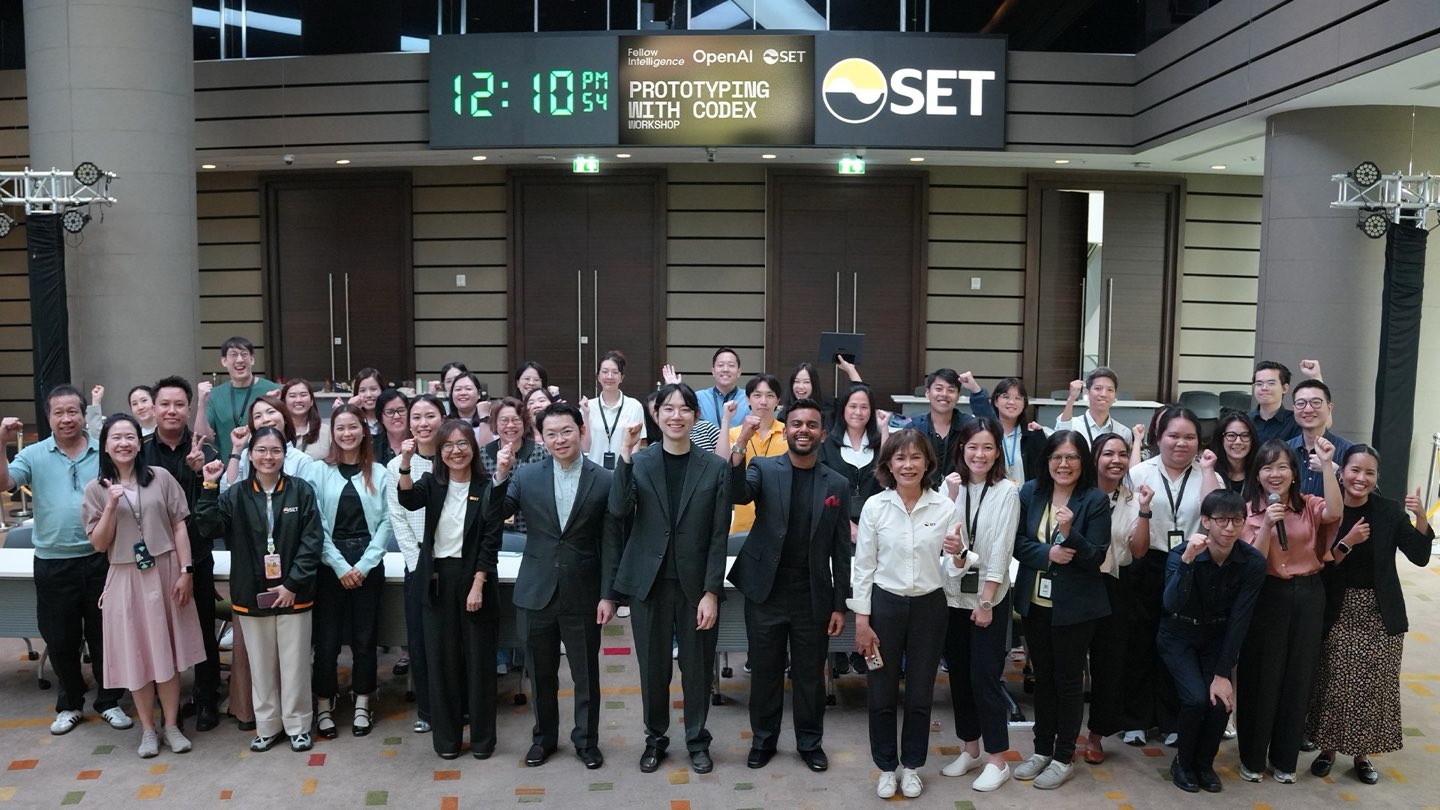
Agentic coding tools like Codex◦ have changed the economics of software development. Writing code is dramatically faster than it was a year ago, and the door is now open for many more people, including non-engineers, to help build early prototypes.DefinitionAgentic coding tool an AI that takes a task, then plans, writes, runs and fixes code across many steps — not just autocompleting a line
Thailand is moving quickly on this. According to OpenAI, weekly active use of Codex in Thailand has grown more than 350x since the start of 2026◦, putting Thailand among the top 20 markets for Codex worldwide.By the numbers350xgrowth in weekly active Codex use in Thailand since January 2026, according to OpenAI
The session
To explore what that means in practice, Fellow Intelligence, together with OpenAI, hosted a session for the team at the Stock Exchange of Thailand (SET) on Software Development Lifecycle in the Age of Agentic AI with Codex.
The room was made up of teams who already work in ChatGPT Enterprise◦ day to day. It reflects that at SET, AI isn't just a project — it's part of a continuous learning journey, growing alongside the technology.1DefinitionChatGPT Enterprise the organisation-wide deployment of ChatGPT, with the admin controls and data protections an enterprise needs. At SET, it is the environment Codex runs inside.1This is driven by one of SET's key priorities: Purposeful People who Transform.
That context shaped the day. The discussion went well beyond AI coding, into how a large organisation adopts AI securely, responsibly and at scale, on a strong foundation of security, privacy and AI governance.◦RelatedWhen usage outruns control
One question guided the session:
How is agentic AI changing the software development lifecycle?
Three shifts were already visible in the room.
1. The constraint moves from writing code to verifying it
Writing code is no longer the expensive part. When most of a code change is written by an agent, both the work and the leverage move to review and testing: making sure what the agent produced actually does what was intended, and being able to prove it.
Teams that invest there early are the ones who get to keep the speed they've gained.
2. Planning and writing a great PRD matter more than ever
We are entering the era of spec-driven development.◦ The quality of the output tracks the quality of the specification.DefinitionSpec-driven development writing the requirements, constraints and acceptance criteria first, then letting the agent build against them
Clear requirements, constraints and acceptance criteria in the PRD◦ have become some of the highest-leverage work an engineering team can do.DefinitionPRD Product Requirements Document: what is being built, for whom, and how you'll know it works
3. A working prototype and a production system are two different finish lines
Codex lets more people contribute at the proof-of-concept (PoC) stage, and developers entering the field today have AI coding assistants in their toolkit from day one. That is a real expansion of who gets to build.
It also means a prototype can look finished long before it is production-ready, and the line between the two is getting harder to see.◦RelatedFrom pilot to rollout
Which makes the Senior Technical Architect more important, not less. Designing for security, scalability and maintainability, then backing that with a rigorous testing process, is where the durable value sits in the age of agentic AI.
I'd love to hear your perspective: how has AI changed the way your team builds software?
Thank you to OpenAI and the team at the Stock Exchange of Thailand (SET) for making this session possible.
Keep reading
Case Study: The Audit That Turned “Not Sure” Into a Plan
A division head answered “not sure” to seven of twelve readiness indicators. Four weeks of asking — not surveying — turned the blind spots into the year's adoption roadmap.

Case Study: Turning Individual AI Wins Into Shared Capability
A capable, well-trained team where nothing compounded: every AI win stayed private. Five harvested workflows and one co-built assistant later, the median user caught up with the best.